If you’ve read much about cat’s claw (Uncaria tomentosa), you’ve likely seen references to pentacyclic oxindole alkaloids or POAs as the compound class behind the plant’s studied properties. Mitraphylline is one of the most frequently named individual compounds within that class, often described as one of the primary alkaloids responsible for cat’s claw’s research profile.
But despite showing up constantly in ingredient lists and marketing copy, mitraphylline itself rarely gets explained in any real depth.
This guide answers what is mitraphylline, walks through what laboratory research has actually found about it and the broader oxindole alkaloid family it belongs to, and draws an important distinction most cat’s claw content skips entirely: the difference between Uncaria tomentosa and Uncaria rhynchophylla, a related but chemically and traditionally distinct species.
A note before diving in: the overwhelming majority of research specifically on mitraphylline is preclinical, laboratory and animal studies, not large-scale human clinical trials. That distinction matters throughout this entire article, and it’s worth keeping in mind rather than treating early research findings as settled conclusions.
What Is Mitraphylline?
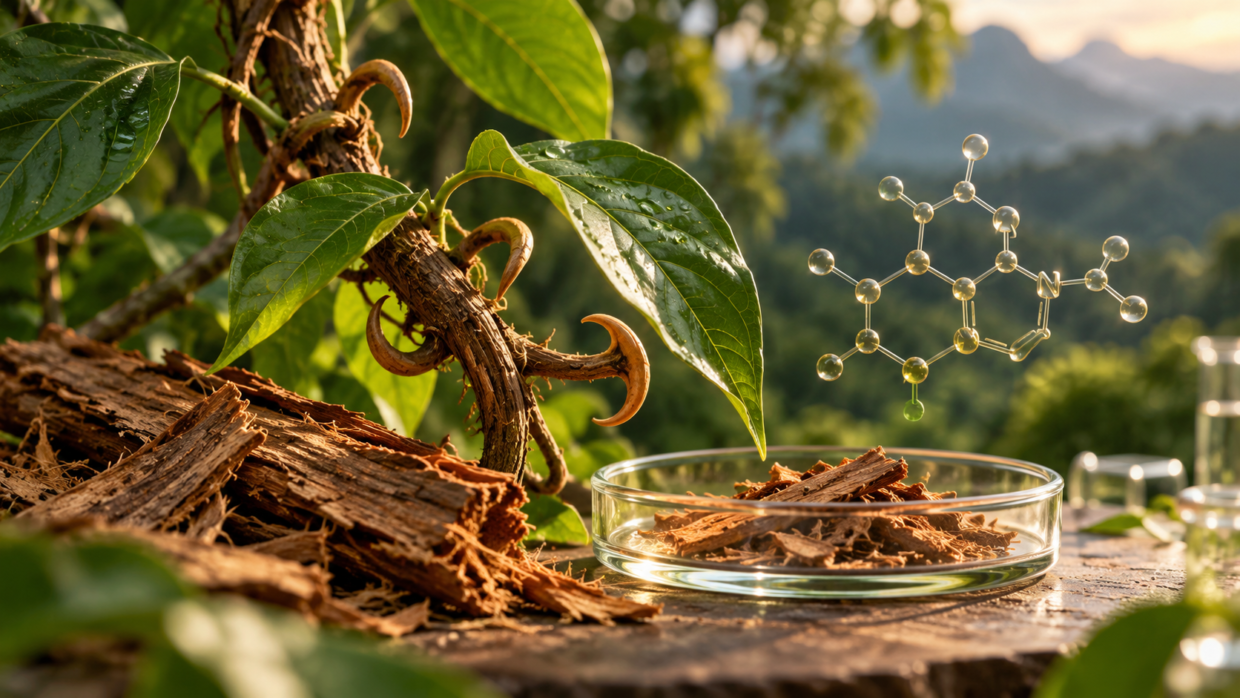
Mitraphylline is a pentacyclic oxindole alkaloid (POA), a nitrogen-containing plant compound characterized by a five-ring molecular structure, found primarily in the bark and root of Uncaria tomentosa, the Amazonian vine most commonly sold as cat’s claw. It’s frequently cited alongside a handful of related POAs (including isomitraphylline, pteropodine, and isopteropodine, among others) as part of the specific alkaloid profile responsible for cat’s claw’s studied immune-modulating and anti-inflammatory properties.
Structurally, mitraphylline belongs to a broader chemical family found across several Uncaria species and some related genera, but its concentration and prominence specifically within Uncaria tomentosa is part of why it’s become one of the most frequently referenced individual compounds in cat’s claw research and product marketing.
When a cat’s claw extract is standardized for “pentacyclic oxindole alkaloid content,” mitraphylline is typically one of the specific compounds contributing to that measured percentage, alongside the other POAs mentioned above.
The Broader Alkaloid Family: POAs and TOAs
Mitraphylline doesn’t exist in isolation within cat’s claw chemistry, it’s part of a two-branch alkaloid system that’s become central to understanding cat’s claw extract quality. Uncaria tomentosa bark contains both pentacyclic oxindole alkaloids and a structurally distinct group called tetracyclic oxindole alkaloids (TOAs), which have a four-ring rather than five-ring structure.
This distinction matters because laboratory research, dating back to work conducted in the 1970s and 1980s, found that TOAs appear to antagonize, or counteract, the immune-modulating activity associated with POAs like mitraphylline. Individual Uncaria tomentosa vines tend to be chemotypically dominated by one alkaloid family or the other, POA-dominant or TOA-dominant, and the two chemotypes are visually indistinguishable without laboratory testing.
This is exactly why serious cat’s claw extract manufacturers standardize not just for total alkaloid content, but specifically for POA content (including mitraphylline) while verifying that TOA content remains low or negligible, since a TOA-heavy extract could theoretically work against the very properties mitraphylline and its related POAs are studied for.
What Laboratory Research Has Found About Mitraphylline
With that chemical context established, here’s a look at what research has actually examined regarding mitraphylline specifically, organized by area of study. It bears repeating throughout this section: the research described below is preclinical, conducted in cell cultures, isolated tissue preparations, or animal models, rather than large-scale controlled human trials.
Anti-Inflammatory Activity
Laboratory research has examined mitraphylline’s potential role in modulating inflammatory pathways, with some studies suggesting it may help inhibit certain inflammatory signaling processes at the cellular level.
This research contributes to the broader body of evidence behind cat’s claw’s traditional and modern reputation for supporting a healthy inflammatory response, though it’s worth noting that isolating mitraphylline’s specific individual contribution, separate from the other POAs it’s typically extracted alongside, is genuinely difficult given how these compounds are studied together as part of whole or partial plant extracts in most existing research.
Immune-Modulating Properties
Mitraphylline and related POAs have been studied for their effects on immune cell activity in laboratory settings, including research examining effects on certain white blood cell functions.
This immune-modulating research is a major part of why cat’s claw carries specific cautions for people with autoimmune conditions or those on immunosuppressant medication, a plant compound capable of influencing immune activity in a laboratory setting is exactly the kind of compound that warrants caution for anyone whose immune system is already being deliberately suppressed or is functioning abnormally.
Antioxidant Activity
Like many plant-derived alkaloids and polyphenolic compounds, mitraphylline has demonstrated antioxidant activity in laboratory research, meaning it’s shown some capacity to help neutralize free radicals and reduce oxidative stress in cell-based studies. This antioxidant property is generally considered to work alongside, and potentially contribute to, some of cat’s claw’s other studied effects, since oxidative stress and inflammation are closely interconnected processes in the body.
Vasodilatory and Cardiovascular-Related Research
Some earlier laboratory research specifically examined mitraphylline’s effects on vascular tissue, with findings suggesting a vasodilatory effect, meaning it appeared to promote relaxation of blood vessel tissue in these isolated studies. Some of this research explored a potential calcium-channel-related mechanism, a pathway also relevant to certain classes of blood pressure medication.
This is a good example of research that’s genuinely interesting mechanistically but remains a long way from a clinical application, isolated tissue and animal studies showing a vasodilatory effect don’t confirm the same effect would be clinically meaningful or safe to rely on in humans, particularly for anyone already taking blood pressure medication, where this research is actually more relevant as an interaction caution than as a potential benefit.
Early Neuroprotective and Cognitive-Adjacent Research
A smaller body of preclinical research has begun exploring mitraphylline and related Uncaria alkaloids in the context of neuroprotection, including some laboratory work examining effects relevant to oxidative stress in neural tissue.
This is a genuinely early-stage research area, much earlier and less developed than the anti-inflammatory and immune research discussed above, and it’s worth flagging specifically because this is exactly the kind of preliminary finding that can get overstated in consumer-facing content if the preclinical caveat isn’t kept front and center.
Why “Preclinical” Matters So Much Here
It’s worth pausing to explain clearly why this article keeps returning to the preclinical distinction, since it’s easy to skim past as boilerplate rather than understanding why it’s genuinely important.
Preclinical research, laboratory (in vitro) studies using isolated cells or tissue, and animal (in vivo) studies, serves a real and necessary purpose in the scientific process. It’s how researchers identify promising compounds and mechanisms worth pursuing further, and it provides genuine, useful information about how a compound behaves in a controlled setting.
But preclinical findings routinely fail to replicate once tested in actual human clinical trials, for reasons ranging from differences in how a compound is absorbed and metabolized in the human body, to dosing concentrations achievable in a lab dish versus a human bloodstream, to the vastly more complex biological environment of a living human system compared to isolated cells.
For mitraphylline specifically, this means the laboratory findings described above represent genuinely interesting, hypothesis-generating research, not proof that taking a cat’s claw supplement containing mitraphylline will reliably produce any of these specific effects in a person.
This is an important distinction to hold onto throughout any discussion of mitraphylline, and it’s exactly why credible sources discussing this compound consistently frame its research in “laboratory studies suggest” terms rather than “mitraphylline does X” terms.
Uncaria Rhynchophylla: A Related but Distinct Species
This is a detail that gets confused constantly in consumer content, and it’s worth untangling clearly. Uncaria tomentosa (cat’s claw) is not the only Uncaria species with a significant traditional medicine history, Uncaria rhynchophylla, commonly known as “Gou Teng” in Traditional Chinese Medicine, is a separate species within the same genus, with its own distinct traditional use, geographic origin, and, importantly, its own distinct primary alkaloid profile.
While Uncaria tomentosa is native to the Amazon rainforest and traditionally used in Peruvian and broader Amazonian herbal medicine, Uncaria rhynchophylla is native to East Asia and has a long history of use specifically within Traditional Chinese Medicine, where the hooked stems (rather than the root bark favored in cat’s claw preparations) are the traditionally used plant part.
Its primary studied alkaloids are rhynchophylline and isorhynchophylline, rather than mitraphylline and the pentacyclic oxindole alkaloids that define Uncaria tomentosa’s chemistry.
Uncaria rhynchophylla’s research base centers on a different area entirely from cat’s claw’s anti-inflammatory and immune focus, most notably, research examining rhynchophylline’s relationship to calming, anti-anxiety, and neuroprotective effects, consistent with its traditional TCM use for conditions involving what’s traditionally described as internal wind or spasm-related patterns, and its inclusion in classical TCM formulas addressing agitation and convulsive conditions.
The practical takeaway: “Uncaria” as a genus covers more ground than “cat’s claw” alone, and mitraphylline specifically is a compound characteristic of Uncaria tomentosa’s chemistry, not Uncaria rhynchophylla’s. A product or article using “Uncaria” broadly without specifying the species is leaving out a genuinely important distinction, since the two species’ traditional uses, primary alkaloids, and research directions are meaningfully different from one another.
A Brief History of Mitraphylline Research
Mitraphylline’s identification traces back to the broader wave of phytochemical investigation into cat’s claw that began in earnest in the latter half of the 20th century, as researchers, most notably Austrian scientist Klaus Keplinger and collaborators, worked to characterize the specific compounds behind Uncaria tomentosa’s traditional Amazonian reputation.
This research effort is what eventually led to the identification of the distinct POA and TOA alkaloid families and their antagonistic relationship, with mitraphylline emerging as one of the more consistently identified and discussed individual POAs within that broader body of work.
Since that foundational period, research interest in mitraphylline has continued in a fairly narrow, specialized scientific niche, primarily pharmacology and phytochemistry journals rather than mainstream medical literature, which is part of why it remains a relatively obscure compound name outside of cat’s claw-focused research circles, despite being referenced constantly in cat’s claw marketing and ingredient lists.
This history is worth knowing because it underscores that mitraphylline isn’t a newly discovered or trendy compound, it’s a decades-old subject of ongoing, incremental scientific investigation, still very much in the preclinical stage of that broader research arc even today.
How Mitraphylline Is Isolated and Studied in the Lab
For anyone curious about the practical side of this research, it’s worth understanding how scientists actually isolate and measure mitraphylline within cat’s claw material, since it explains both why POA-family compounds are usually studied together and why standardization is such a technically involved process.
Extracting mitraphylline from Uncaria tomentosa bark typically involves a multi-step process: the raw bark is dried and ground, then subjected to solvent extraction (commonly using water, ethanol, or a combination) to pull the alkaloid content out of the plant matrix.
From there, high-performance liquid chromatography (HPLC) is used to separate and identify individual compounds within the resulting extract, including distinguishing mitraphylline from its closely related structural relatives like isomitraphylline, and separating the POA family as a whole from the counteracting TOA family discussed earlier.
Because mitraphylline and its related POAs share such similar chemical structures, isolating a single one of these compounds in high purity for standalone laboratory study is considerably more technically demanding than working with the natural POA mixture as it occurs in the plant.
This is part of the practical reason so much existing research examines cat’s claw extracts as a whole, or the broader POA fraction, rather than mitraphylline in complete isolation, it reflects a genuine technical reality of working with this specific class of plant chemistry, not a lack of scientific interest in the compound itself.
What This Means for Evaluating a Cat’s Claw Extract
Given everything above, here’s how the mitraphylline and broader alkaloid discussion translates into practical label-reading for anyone evaluating a cat’s claw product specifically:
- Species matters first. A product should specify Uncaria tomentosa, not just “Uncaria” or “cat’s claw” generically, given the meaningful chemical differences between tomentosa and other Uncaria species like rhynchophylla.
- POA standardization is the more informative marker than a general “alkaloid content” claim. Since mitraphylline is one of several POAs contributing to cat’s claw’s studied properties, a product specifying a standardized POA percentage is providing more useful information than a vague total alkaloid figure that doesn’t distinguish between POAs and the counteracting TOA family.
- TOA verification adds a further layer of assurance. Given the antagonistic relationship between TOAs and POAs described earlier, products explicitly tested and verified as low-TOA or TOA-free represent a more complete quality picture than POA content alone.
- Individual compound claims deserve skepticism. Because mitraphylline is typically present as part of a broader POA mixture in real-world extracts, and because the bulk of its specific research is preclinical, be cautious of marketing language implying mitraphylline alone, isolated from the broader extract and its other alkaloids, has been proven to deliver a specific clinical outcome in humans.
Learn More About Cat’s Claw
If you’re interested in the bigger picture beyond mitraphylline specifically, including cat’s claw’s traditional Amazonian origins, its broader research profile, and safety considerations, our full guide on what cat’s claw is used for covers that ground in more depth.
Frequently Asked Questions
Is mitraphylline the only important alkaloid in cat’s claw?
No. Mitraphylline is one of several pentacyclic oxindole alkaloids (POAs) found in Uncaria tomentosa, alongside compounds like isomitraphylline, pteropodine, and isopteropodine. Most research and product standardization considers the POA family collectively, rather than isolating mitraphylline as the single active compound.
Has mitraphylline been tested in human clinical trials?
The large majority of research specifically on mitraphylline is preclinical, laboratory and animal studies, rather than controlled human trials. This is an important distinction, since preclinical findings don’t always replicate in human research.
Is Uncaria rhynchophylla the same as cat’s claw?
No. Uncaria rhynchophylla (Gou Teng) is a related but distinct species from Uncaria tomentosa (cat’s claw), with a different traditional use system (Traditional Chinese Medicine rather than Amazonian herbal medicine), a different primary plant part used (hooked stems rather than root bark), and a different primary alkaloid profile (rhynchophylline and isorhynchophylline rather than mitraphylline).
Why do cat’s claw products specify POA content instead of just listing mitraphylline?
Because mitraphylline typically occurs alongside several other related POAs in natural extracts, and because these compounds are generally studied and standardized as a collective class rather than in isolation, POA content is the more practically meaningful and commonly used standardization marker.
Should I be concerned if a product doesn’t mention mitraphylline by name?
Not necessarily. A product specifying overall POA content (which includes mitraphylline among other related alkaloids) and, ideally, verified low TOA content, is providing more complete and useful information than one that names mitraphylline specifically but doesn’t disclose broader alkaloid standardization.
Final Thoughts
Mitraphylline is a genuinely interesting compound, and the laboratory research examining its anti-inflammatory, immune-modulating, antioxidant, and even early neuroprotective properties helps explain, at a mechanistic level, why cat’s claw has attracted so much research interest in the first place.
But understanding mitraphylline responsibly means holding two things at once: real, legitimate scientific interest in what this compound appears to do in laboratory settings, and honest acknowledgment that human clinical confirmation remains limited.
It’s also worth remembering that mitraphylline is a Uncaria tomentosa story specifically, not a story about the broader Uncaria genus, Uncaria rhynchophylla’s very different alkaloid profile and traditional use is a useful reminder that not every plant sharing a genus name shares the same chemistry or the same research findings. Keeping these distinctions clear is what separates a genuinely informed understanding of cat’s claw extract from a blurred, oversimplified one.
More Resources
Affinity Kratom Review: A Deep Dive